Millimeters to Inches Converter
Millimetres are the unit of choice for anything small and precise – hardware, phone dimensions, engineering drawings. To convert to inches you divide by 25.4 (since one inch is exactly 25.4 mm); to go back you multiply. Where millimetres and inches really clash is fractions, so there is a fraction table below.
Millimetres you can picture
A credit or bank card is 0.76 mm thick – about 1/32 inch. An AA battery is 14.5 mm across (0.57 in). A CD is 120 mm in diameter, which is 4.72 in. A US quarter is 24.26 mm (0.955 in). Once you have a couple of these in your head, a stray factor-of-ten error in an mm reading is easy to catch.
Millimetres to fraction inches (hardware sizes)
| mm | Decimal inch | Nearest fraction |
|---|---|---|
| 1.6 mm | 0.063 in | 1/16 in |
| 3.2 mm | 0.126 in | 1/8 in |
| 6.35 mm | 0.250 in | 1/4 in |
| 9.5 mm | 0.374 in | 3/8 in |
| 12.7 mm | 0.500 in | 1/2 in |
| 19.05 mm | 0.750 in | 3/4 in |
| 25.4 mm | 1.000 in | 1 in |
Need the fraction from an odd decimal? The fraction and decimal converter rounds to the nearest 64th.
A note on precision
Because 1 mm is 0.0393700787… inches, a “1 mm = 0.03937 in” rule of thumb is fine for a shelf but not for a machined part. The converter carries full precision internally and only rounds the number it shows you. If you are matching a metric bolt to an imperial thread, don’t – the thread pitches differ, and no amount of unit conversion makes an M6 fit a 1/4-20 hole. For larger distances use the length converter; to go the other way, the inches to cm converter also shows millimetres.
FAQ
How do I convert mm to inches?
Divide the millimetre value by 25.4. For example, 50 mm ÷ 25.4 = 1.9685 in. To convert inches to mm, multiply by 25.4.
What is 10 mm in inches?
10 mm is 0.3937 inches - just under 25/64 in, or roughly 3/8 in for practical purposes.
Is 25 mm the same as 1 inch?
Almost. One inch is 25.4 mm, so 25 mm is about 0.984 in - close, but 0.4 mm short.
What fraction of an inch is 5 mm?
5 mm is 0.1969 in, which is very close to 13/64 in, or a hair under 1/5 in.
Why do drawings mix mm and fraction inches?
Older tooling, fasteners and timber in the US and UK are still sized in fractions of an inch, while most modern manufacturing is metric. Conversion tables like the one above bridge the two.
Related Articles
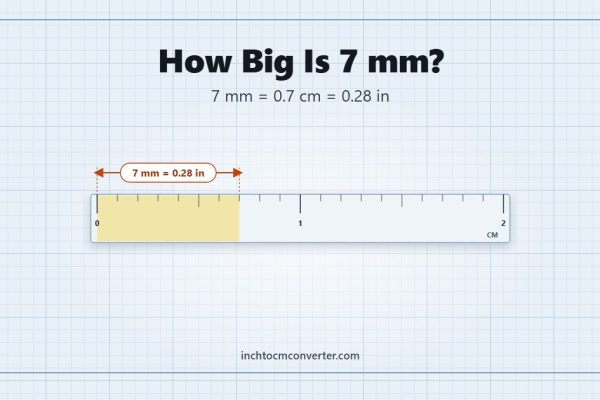
How Big Is 7mm? Size in Inches With Everyday Examples
7mm equals about 0.28 inches -- about the width of a standard pencil, four US quarters stacked, or the thickness of a smartphone.
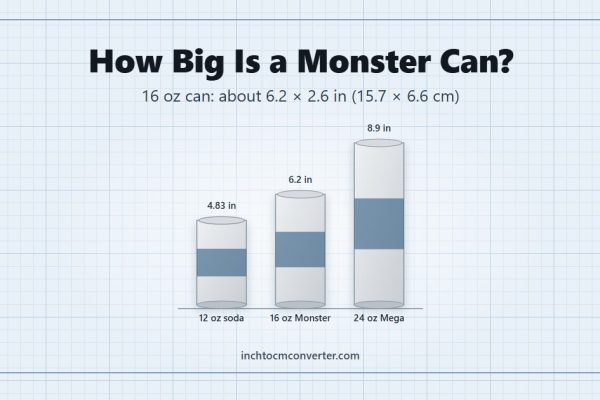
Monster Can Size: Height and Width in Inches and cm
A standard 16 oz Monster can is about 6.2 in tall and 2.6 in wide (15.7 x 6.6 cm), the same width as a soda can. Plus the 24 oz Mega Monster and caffeine.
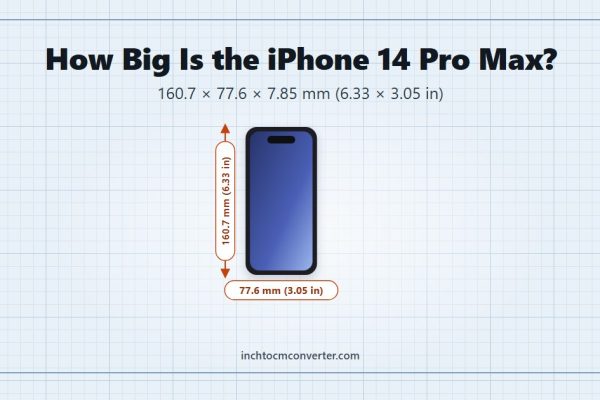
iPhone 14 Pro Max Size: Dimensions in Inches, cm and Weight
The iPhone 14 Pro Max measures 6.33 inches tall and 3.05 inches wide -- noticeably bigger than the standard iPhone 12.
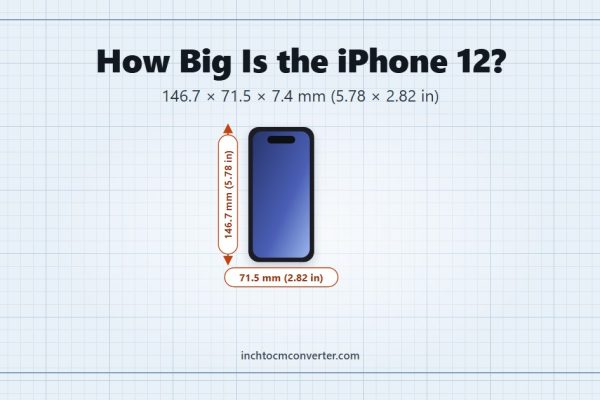
iPhone 12 Size: Dimensions in Inches, cm and Weight
The iPhone 12 measures 5.78 inches tall and 2.82 inches wide -- almost exactly the standard smartphone height.