Miles to Kilometers Converter
One mile is 1.609344 kilometres. That awkward number is why people reach for shortcuts: multiply miles by 1.6, or – more accurately – add half again plus a bit. Going the other way, kilometres × 0.621 gives miles. This page has the tables and the two mental tricks worth knowing.
The mental math that holds up
The cleanest trick uses the Fibonacci-style coincidence that consecutive numbers in the sequence 3, 5, 8, 13, 21 are roughly a mile-to-km pair: 5 miles ≈ 8 km, 8 miles ≈ 13 km, 13 miles ≈ 21 km. It is accurate to about 0.5%. For odd values, “miles × 1.6” is close enough for driving, and “km × 0.6” gets you back. A 60 mph limit is 96.6 km/h; 30 mph is 48 km/h.
Running and driving distances
| Miles | Kilometres | What it is |
|---|---|---|
| 3.1 mi | 5 km | a 5K race |
| 6.2 mi | 10 km | a 10K race |
| 13.1 mi | 21.1 km | a half marathon |
| 26.2 mi | 42.2 km | a marathon |
| 60 mi | 96.6 km | a US freeway hour |
Miles, nautical miles and speed
The mile here is the statute mile used on roads. A nautical mile is different – 1.852 km – and only turns up in aviation and at sea. If you are converting a pace or a speed rather than a distance, the speed converter handles mph, km/h, knots and m/s together. For shorter distances, drop to the feet to metres or length converter.
FAQ
How do I convert miles to km?
Multiply miles by 1.609344. For a quick estimate, multiply by 1.6. So 10 miles is about 16.1 km.
How many km is a marathon?
A marathon is 26.2 miles, which is 42.195 km - the distance has been fixed since the 1908 London Olympics.
What is 100 km in miles?
About 62.1 miles (100 × 0.621371).
Is a mile always 1.6 km?
The statute (road) mile is 1.609 km. A nautical mile, used at sea and in the air, is 1.852 km - a different unit.
What speed limit is 100 km/h in mph?
About 62 mph. Common conversions: 50 km/h ≈ 31 mph, 100 km/h ≈ 62 mph, 120 km/h ≈ 75 mph.
Related Articles
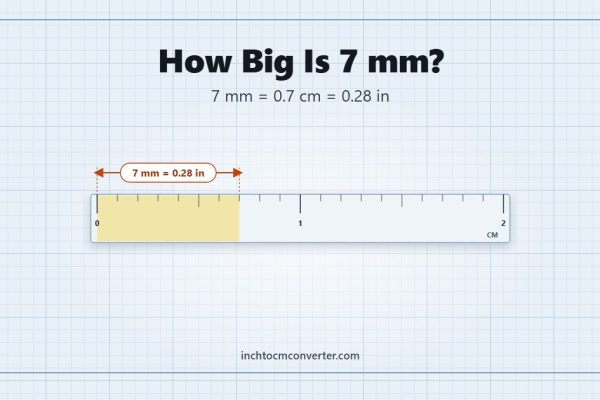
How Big Is 7mm? Size in Inches With Everyday Examples
7mm equals about 0.28 inches -- about the width of a standard pencil, four US quarters stacked, or the thickness of a smartphone.
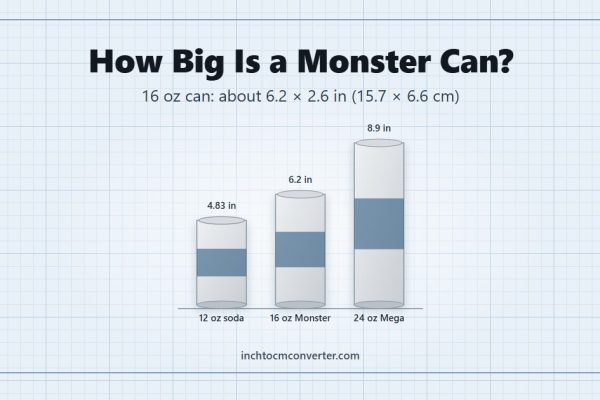
Monster Can Size: Height and Width in Inches and cm
A standard 16 oz Monster can is about 6.2 in tall and 2.6 in wide (15.7 x 6.6 cm), the same width as a soda can. Plus the 24 oz Mega Monster and caffeine.
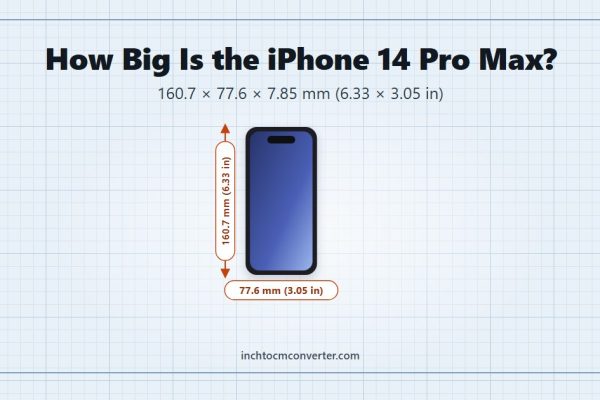
iPhone 14 Pro Max Size: Dimensions in Inches, cm and Weight
The iPhone 14 Pro Max measures 6.33 inches tall and 3.05 inches wide -- noticeably bigger than the standard iPhone 12.
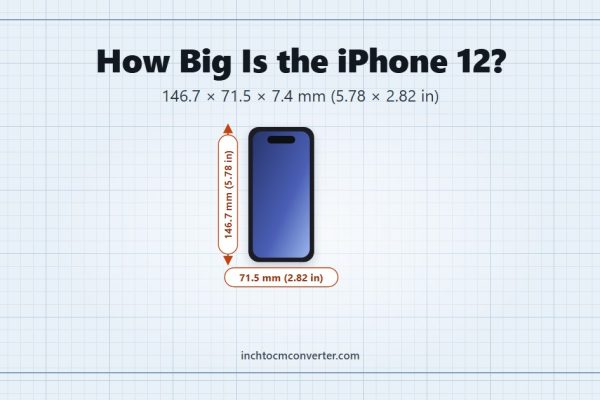
iPhone 12 Size: Dimensions in Inches, cm and Weight
The iPhone 12 measures 5.78 inches tall and 2.82 inches wide -- almost exactly the standard smartphone height.